Outdoor & Landscape Lighting
Two kinds of outdoor lighting, done right: low-profile path and landscape lights that line walkways, driveways, and planting beds, and LED strip lighting along deck rims, patios, and stair risers. Outdoor-rated, transformer-wired, and built to hold up through Chicago winters.
Overview
MarioScape installs two kinds of low-voltage outdoor lighting. Path and landscape lighting — the low-profile, warm-white fixtures that line walkways, driveways, and planting beds for safe footing and curb appeal after dark — is part of nearly every landscape design. LED strip lighting handles the architectural glow along decks, patios, and stair risers. Both run low-voltage off a standard outdoor outlet.
Outdoor lighting is one of those projects where the difference between a five-year install and a one-season install is component choice — not skill. Indoor strips wrapped in silicone aren't outdoor-rated. Cheap transformers from a big-box store aren't rated for outdoor wet locations. The result: water gets into the connections, corrodes the LEDs, the strip flickers, dies, gets replaced, dies again.
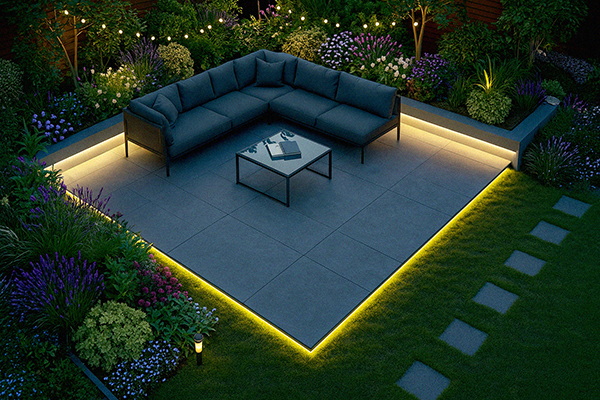
MarioScape installs outdoor-rated, low-voltage LED strip lighting for North Shore homes. weatherproof, outdoor-rated housings, outdoor-rated low-voltage wire, a proper outdoor-rated transformer matched to load, and concealed mounting wherever the surface allows. Clean install that disappears into the architecture by day and lights up the space at night.
Low-voltage systems run off a standard outdoor GFCI outlet — no electrician needed, no permit, no panel work. If a project needs a new outlet added, that part gets referred to a licensed electrician before the lighting install.
What's included
Plain English, no padding.
Low-profile, warm-white LED path lights that line walkways, driveways, and planting beds — for safe footing at night and curb appeal after dark.
Fixtures are spaced evenly along walks and beds (typically 8–10 ft on center), wired to a proper outdoor-rated low-voltage transformer, and set on a timer or photocell so they come on at dusk on their own. Warm white (2700K) is standard — the same path lighting mapped into every landscape design. Solid, durable fixtures, not the hollow plastic stakes that crack and yellow in a season.
Outdoor-rated LED strip lighting installed along deck rims, patio borders, stair risers, planter edges, or wherever you want defined linear glow.
Install includes site walkthrough, route planning, mounting (concealed where possible, surface-mounted with color-matched housing where not), sealed, weatherproof connections, outdoor-rated low-voltage wire run to a proper outdoor-rated transformer, and tie-in to a standard outdoor GFCI outlet. Transformer can be timer-controlled, photocell-triggered, or Wi-Fi smart depending on what you want. Color options: warm white (most common), cool white, RGB color-changing.
Common Questions
Both. Path and landscape lighting — the low-profile, warm-white fixtures that line walkways, driveways, and planting beds — is the more common request and part of most landscape designs. LED strip lighting handles deck, patio, and step edges. Plenty of properties end up with both.
String lights hang overhead and create ambient mood — decorative. Outdoor LED strips mount along edges and create defined linear glow — functional plus aesthetic. Strips look integrated; strings look festive. Most homeowners end up wanting both for different zones.
Properly installed outdoor strips use weatherproof, outdoor-rated housings, outdoor-rated wire, and a proper outdoor-rated transformer. The right components hold up for years on the North Shore through freeze-thaw cycles.
No. Low-voltage LED strip systems run off a transformer that plugs into a standard outdoor GFCI outlet. No 120V wiring, no panel work, no permit required. If a project requires adding a new GFCI outlet, that part gets referred to a licensed electrician.
Pricing depends on linear footage, mounting complexity, and whether multiple zones with separate transformers are needed. Larger custom installs run higher. Reach out for a walk-through and quote.
Yes — concealed mounting is the preferred install method when the surface allows it. Strips tucked under deck rails, behind step risers, into railing undersides, or behind planter rims. You see the light, not the strip.
Yes, on systems built with smart transformers. Wi-Fi-controlled transformers let you turn zones on, dim, schedule, and (with color-capable strips) change color from a phone app. Standard installs use timer-controlled or photocell-triggered transformers if smart control isn't needed.
Service Area
Primary service area below. Most lighting installs are a one-day or two-day job depending on scope.
Tell me what space you're trying to light up and I'll come walk through with options — usually a same-day quote.
